
Millions of Videos, One Problem: Finding the Right One
Open almost any adult platform and you will be greeted by a number. Millions of videos. Tens of thousands of performers. Hundreds of new uploads a day. These figures are meant to impress, and for a while they did. But a headline count answers a question almost nobody is actually asking. People do not arrive hoping to be told how much exists. They arrive hoping to find the one thing that fits.
That gap — between how much a platform holds and how much of it a person can realistically reach — is the defining challenge of adult discovery. Inventory and usefulness are not the same thing, and confusing the two has shaped the industry for years.
Volume is a vanity metric
A catalogue’s raw size tells you almost nothing about a visitor’s experience. What matters is a much smaller number that platforms rarely advertise: how many of those items a given person will ever actually see, and of those, how many match what they wanted. If a library contains millions of videos but a visitor only ever encounters the same few hundred surfaced by a blunt algorithm, the true working catalogue is tiny. The rest might as well not exist.
This is why a well organized collection of modest size can feel far richer than a sprawling one. A smaller library where everything is findable delivers more usable value than an enormous one where most of the content is effectively invisible. Discoverability, not volume, is what turns stored content into experienced content.
How good content becomes unreachable
Content disappears inside large platforms for reasons that have nothing to do with quality. Duplicate uploads scatter viewers across near-identical copies. Titles are wildly inconsistent, describing the same thing in a dozen incompatible ways. Tags are either so broad they are meaningless or so haphazard that similar material never clusters together. Each of these is a small failure of organization, and together they bury an enormous amount of perfectly good material under a layer of noise.
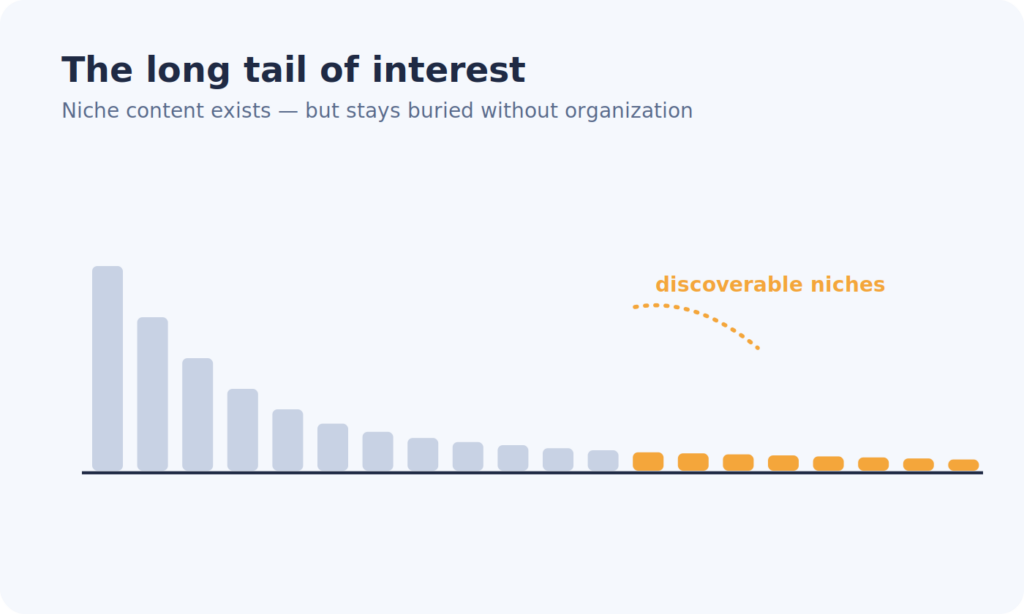
Most catalogues have a long tail of niche content that genuinely exists but stays buried without deliberate organization.
The long tail nobody can reach
Every large catalogue has a long tail: a vast number of niche items that each appeal to a smaller audience but collectively make up most of the library. In a well designed system, that tail is a treasure, because it is where specific tastes are satisfied. In a poorly organized one, the tail is a graveyard. The content exists, the audience for it exists, and yet the two never meet because nothing connects them. The niche was served in theory and abandoned in practice.
People search by preference, not by taxonomy
Part of the problem is that platforms organize content the way a filing cabinet would, while people search the way a mind actually works. Someone rarely thinks in terms of a site’s official category tree. They think in terms of a particular combination of preferences, a specific dynamic, a mood, a detail. Those mental searches cut across formal categories and almost never line up with a single tidy label.
This is especially true for specific interests. Enthusiasts of a particular niche tend to know exactly what they are looking for, and they describe it in their own vocabulary rather than the platform’s. A discovery system that lets people follow specific interests as first-class paths — organized deliberately rather than dumped into an overflowing catch-all tag — is often the difference between a satisfied visitor and one who concludes the content simply is not there. Careful organization of niche interests is not a side feature; for a large share of users it is the whole point.
Connecting related interests
Where artificial intelligence becomes genuinely useful is in mapping how interests relate to one another. Preferences rarely exist in isolation. Someone drawn to one theme frequently has adjacent tastes, and a system that understands those relationships can guide a person from what they typed toward related things they would have loved but never thought to search for. That is discovery in its truest sense: not just retrieving the obvious match, but revealing the relevant neighbor.
This relational view also reframes what a recommendation is for. In a volume-obsessed system, recommendations mostly recycle whatever is already popular, which pushes everyone toward the same narrow slice of the catalogue. In a discovery-first system, recommendations do the opposite: they widen the path, using the connections between content to lead a curious person deeper into the parts of the library that fit them specifically. The difference is between an engine that flattens taste and one that follows it.
That relational approach is what a structured discovery index makes possible. PornPrompt is built as a searchable adult content index that leans on organization and AI-assisted matching rather than raw scale, with the aim of making a large catalogue behave like a small, well curated one. The promise is not another record-breaking video count. It is that more of the catalogue actually becomes reachable.
Organization is a form of respect for the viewer
There is a human dimension to all of this that pure numbers miss. When a platform buries its content behind poor organization, it is quietly telling visitors that their time is not worth much — that they should be grateful for the pile and do the digging themselves. A well organized catalogue says the opposite. It treats the visitor as someone with a specific intent worth honoring, and it does the work of connecting them to it.
That respect tends to pay off in loyalty. People return to places that reliably understand them and drift away from places that make every visit feel like a chore. In a market where nearly everyone can claim a huge catalogue, the platform that treats a person’s attention as valuable has an advantage that a bigger inventory cannot buy.
The metric that should replace the count
If the industry is going to grow up, it needs a better yardstick than inventory. A more honest measure would ask what fraction of the catalogue any given visitor can realistically discover, and how often a search ends in genuine satisfaction rather than a reluctant compromise. By that standard, a platform’s job is not to accumulate the most content. It is to waste the least of it.
Millions of videos was always a solvable problem in the wrong direction. The interesting work is not adding the next million; it is making sure the millions already sitting there can finally be found.